
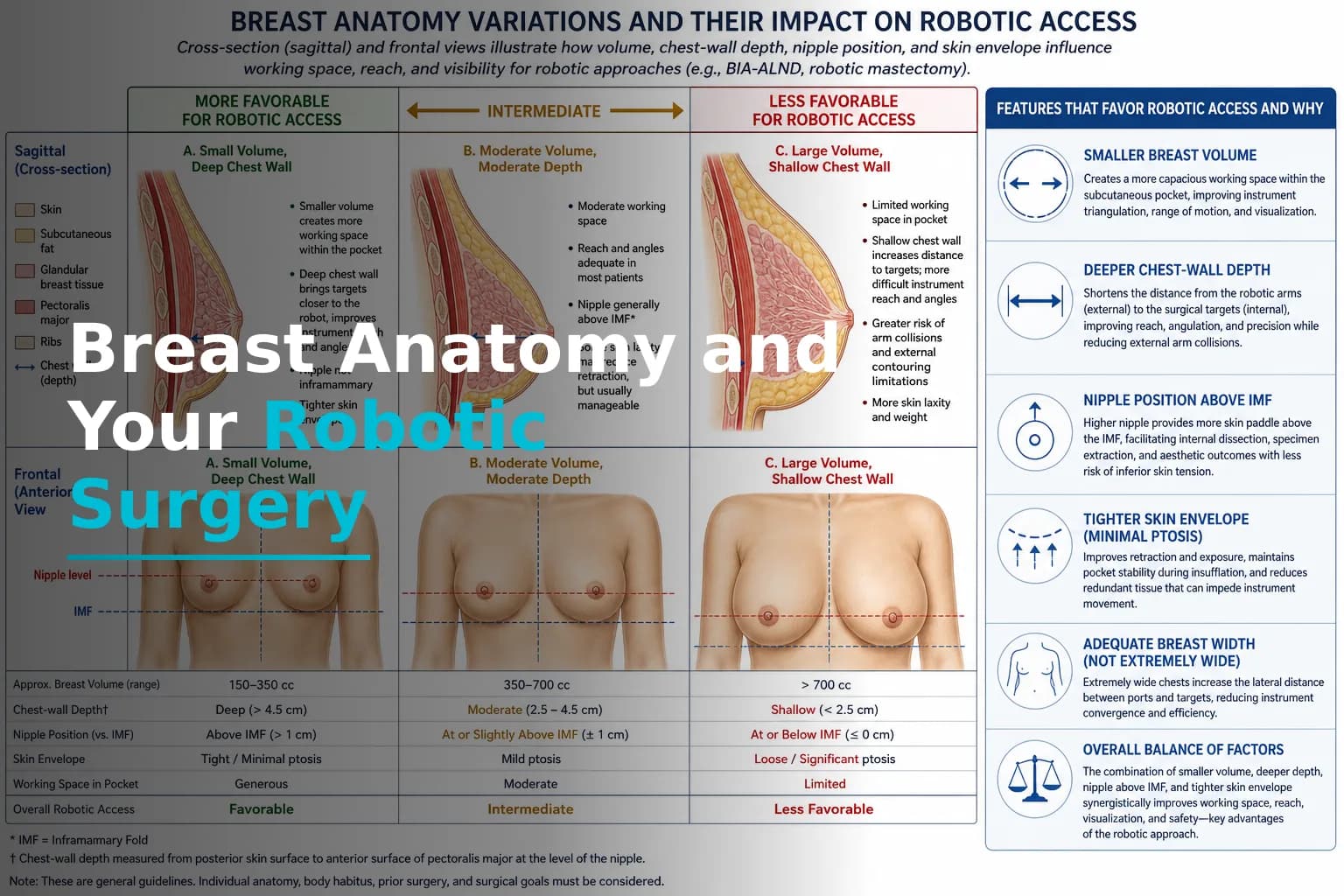
Your breast size, shape, density, and tumor location all affect which surgical techniques your care team considers. This is especially true for robotic approaches, such as robotic nipple-sparing mastectomy and robotic-assisted lumpectomy, where your breast's shape can open or close the options available to you.
Learning how anatomy affects your surgery helps you ask better questions at your appointment. Techniques you thought were not possible might actually work for you.
Why does anatomy matter in robotic breast surgery?
Robotic breast surgery uses small incisions, often in the armpit or along the natural breast fold, and a robotic arm that carries a camera and fine instruments inside the breast. For this to work safely, several things must be right: enough tissue to work with, healthy skin, and enough distance from the tumor to key structures like the nipple.
Unlike open surgery, where a surgeon adapts to what they find, robotic surgery requires precise advance planning. This planning requires a careful understanding of your anatomy.
According to Cancer Research UK, several factors affect which breast surgery is best for you - including tumor size and position relative to the rest of the breast, and whether cancer is in more than one area.
How breast size shapes your surgical options
Robotic breast surgeons first consider breast size. It affects both how they do the surgery and how you'll look afterward.
For robotic nipple-sparing mastectomy (NSM), where the surgeon removes all breast tissue but keeps the skin, nipple, and areola, smaller to medium-sized breasts tend to work best. Clinical standards show that women with A to C cup sizes do best with this approach. Larger breasts (D cup and up) can still work, but the procedure is harder and results are less predictable.
With larger breasts, the skin might droop more than what the reconstruction can fill evenly. Surgeons might instead consider a skin-reducing mastectomy, where they remove excess skin along with the breast tissue.
For breast-conserving surgery, Macmillan Cancer Support explains that doctors try to remove the cancer while keeping as much breast tissue and shape as possible. If your breast is large compared to your tumor, keeping the breast with a good look is usually easier. A smaller tumor in a larger breast leaves more tissue to close around and reshape. For women with smaller breasts, even a small tumor can be a large part of the breast, and this might affect whether you can keep the breast.
What breast drooping (ptosis) means for nipple preservation
Ptosis is the medical term for breast drooping. Doctors grade it from 0 to 3. In Grade 0, the nipple sits above the fold under the breast. By Grade 3, the nipple has dropped well below that fold and points downward.
For nipple-sparing mastectomy, clinical standards say Grade 0 to 2 ptosis usually gives good results. At Grade 3, keeping the nipple and filling the skin so it looks natural is much harder. The nipple might sit in an odd position after reconstruction, and it's hard to fix without more surgery.
Research in PubMed Central has looked at nipple-sparing mastectomy for women who don't meet standard requirements, including those with more drooping. Selected patients can still get good outcomes with careful planning, but they do best with a surgeon who has done many robotic NSM procedures.
Robotic access through the armpit can sometimes help with mild drooping because the angle lets the surgeon work across more breast tissue. But this depends on your specific case and isn't always possible.
How tumour location affects your surgical approach
Where your tumor sits is one of the most important anatomy factors in planning your surgery. Surgeons divide the breast into five areas: upper outer, upper inner, lower outer, lower inner, and central. Where your tumor is affects whether you can keep the breast or need a mastectomy.
For surgery to save the breast, the upper outer area (closest to the armpit) is usually easiest. Removing tissue there tends to preserve the visible breast shape well. Tumors in the lower inner area or the center are harder to remove while keeping a natural shape, because removing tissue from there changes how the breast looks more.
Research shows that breast-conserving surgery can work for carefully selected patients with tumors in the center - a group that doctors used to say needed a full mastectomy. Oncoplastic techniques combine cancer removal with breast reshaping in one operation, and they often make conservation work in these cases.
For nipple-sparing mastectomy, the key measurement is the tumor-to-nipple distance (TND), which is the gap between your tumor and the nipple-areola complex (NAC). The nipple needs healthy tissue around it to be safely kept. Guidelines usually call for at least 2 cm of distance.
A distance under 1 cm used to mean the nipple had to be removed, but newer research shows that careful testing during surgery can make NSM work even with less distance. A 2025 study found that robotic nipple-sparing mastectomy preserved the nipple about 85% of the time when the distance was less than 1 cm, compared with about 98.5% when the distance was 1 cm or more. This research shows that robotic surgery might let more patients keep their nipples.
What breast density means for your surgery planning
Breast density describes how much fibrous and glandular tissue your breast contains compared with fatty tissue. Dense breasts have more glandular tissue. Doctors grade density on imaging as fatty, scattered, dense, or very dense.
Density doesn't directly determine your surgery, but it affects two important things:
- How clearly your tumor shows on imaging - dense tissue makes mammograms hard to read, so your team might use ultrasound or MRI to see your tumor's true size and extent before planning surgery.
- Whether there are other areas of cancer - dense breasts have higher risk, so your surgeon will want to be sure imaging shows everything before choosing to save your breast.
If you have dense breasts, you can learn more in a guide on dense breast tissue and your choices.
How skin quality affects your reconstruction options
In a nipple-sparing or skin-sparing mastectomy, your breast skin holds whatever reconstruction is put inside. The quality, thickness, and elasticity of your skin is important.
Several things can hurt skin quality or how well it heals:
- Previous radiotherapy to the chest makes skin thinner and less stretchy, which raises the risk of problems after nipple-sparing or skin-sparing surgery.
- Heavy smoking reduces blood flow to the skin, which slows healing and raises the risk of nipple necrosis (when the kept nipple doesn't survive surgery).
- Uncontrolled diabetes and circulation problems also hurt how well skin heals after surgery.
- Large weight changes can affect how well your skin holds its shape after reconstruction.
If you've had chest radiotherapy before (for example, to treat lymphoma or earlier breast cancer), tell any surgeon you see about this. It might change what type of reconstruction your surgeon suggests.
Which anatomy factors affect robotic nipple-sparing mastectomy eligibility?
The table below shows the anatomy factors your surgeon will check when deciding if robotic nipple-sparing mastectomy is right for you. No single factor decides it on its own. Each factor is weighed with the others, and experienced teams can sometimes work around one challenge if the rest is good.
| Anatomical factor | Ideal for robotic NSM | Challenge for robotic NSM |
|---|---|---|
| Breast size | A to C cup | D cup and up - can work but results are harder to predict |
| Breast ptosis (drooping) | Grade 0 to 2 | Grade 3 - the nipple might sit in an odd position after surgery |
| Tumor-to-nipple distance | 2 cm or more | Under 1 cm - the nipple might not be safe to keep; it depends on your case |
| Tumor location | Peripheral areas (upper outer, upper inner) | Central or behind the nipple - the nipple might need to be removed |
| Skin quality | Good elasticity; no prior chest radiotherapy | Previous chest radiotherapy or heavy smoking - higher risk of skin and nipple problems |
Information from published studies including PMC 12102034 and PMC 12390860. A qualified surgeon must assess whether this surgery is right for you.
No single anatomy factor decides whether you can have robotic NSM. Your surgeon weighs breast size, ptosis grade, tumor position, and skin condition together. A surgeon who does many robotic NSM procedures might be able to work around one challenge if the rest looks good.
Can anatomy be worked around?
In some cases, yes. Chemo given before surgery to shrink the tumor can increase the distance from tumor to nipple, and this might make nipple-sparing surgery possible when it wasn't before. Ask your oncologist about this if you've been told your tumor is too close to the nipple for NSM.
Oncoplastic techniques can reshape the remaining breast tissue after removing the tumor, making conservation work in cases where a simple lumpectomy would leave an uneven look. Hospitals with specialists increasingly combine these techniques with robotic surgery.
A "no" from one surgeon doesn't have to be the final answer. Eligibility for surgery is a clinical judgment, and different experienced teams might decide differently about the same anatomy.
If you want a second opinion before deciding on your surgery, you can ask Art of Healing Cancer for a second opinion.
Questions to ask at your surgical consultation
When you meet with your surgeon, ask about how your anatomy affects your surgery options:
- What is my tumor-to-nipple distance on imaging, and does this affect my nipple-sparing options?
- How does my breast size and shape affect which reconstruction approaches will work best for me?
- Is my skin in good enough condition for a skin-sparing or nipple-sparing approach?
- Could chemo before surgery change my surgical options if my tumor is currently too close to the nipple?
- Are robotic or minimally invasive techniques available for my specific anatomy and tumor position?
You can read more about what to ask your surgeon and who qualifies for robotic surgery.
You can also contact BreastCancer.One to discuss your case.
When to talk to your doctor
Talk to your surgeon or breast care nurse if you are unsure whether your anatomy makes a particular technique possible. Ask specifically about your tumor-to-nipple distance, your ptosis grade, and whether chemo before surgery might expand your options. If your concerns about how you'll look haven't been addressed, get a second opinion from a surgeon who specializes in robotic or minimally invasive surgery. Most surgeons support this.
This information is not medical advice. Talk to your oncologist or care team about your situation.