
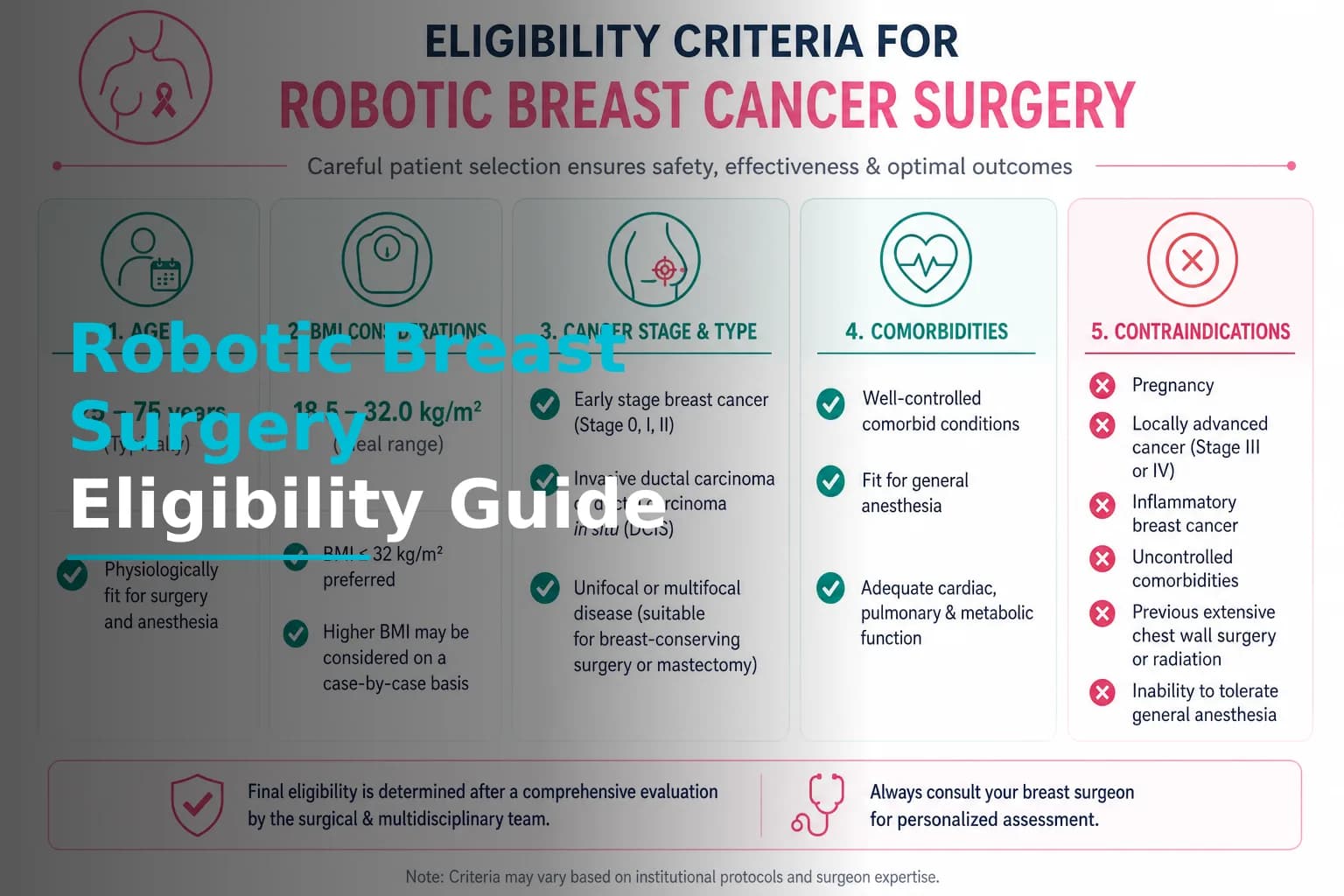
Not every woman with breast cancer will be offered robotic surgery. This isn't a limit on surgeon ambition - it's how carefully they match a technique to each patient. Knowing the eligibility criteria before your consultation helps you ask better questions and make a better decision.
Robotic breast surgery uses a robotic system - most commonly the da Vinci platform - to give surgeons magnified 3D vision and precise instrument control through small ports instead of a long open incision. It is linked to smaller scars, less blood loss, and faster recovery for many women. But the technique has specific requirements, and not every tumour, breast type, or health history will meet them.
The short answer: women with early-stage breast cancer (stage I or II), tumours under 5 cm, no skin or chest-wall invasion, and no inflammatory breast cancer are most likely to qualify. BRCA mutation carriers seeking risk-reducing mastectomy are also often good candidates. If your situation is different, a conventional open approach or another technique may work better - and a specialist surgeon should tell you so clearly.
Are You a Good Candidate for Robotic Breast Cancer Surgery?
| Factor | Typically Suitable | May Need a Different Approach |
|---|---|---|
| Cancer stage | Stage 0 (DCIS), stage I, or stage II | Stage III (especially inflammatory breast cancer) or stage IV |
| Tumour size | Generally under 5 cm with clear skin margins | Large tumours with skin involvement or chest-wall extension |
| Skin and chest-wall involvement | No skin invasion; chest wall free of disease | Tumour invading the skin or underlying chest-wall muscles |
| Breast size and shape | Small to moderate breast size; minimal droop (ptosis) | Very large or significantly drooping breasts in some protocols |
| Prior radiotherapy | No previous chest or thoracic radiation | Prior radiation to the chest area may compromise tissue quality |
| General health | Fit for general anaesthesia; stable health conditions | Poorly controlled diabetes, heart failure, or renal disease; high anaesthesia risk |
Sources: Toesca et al., Robotic Nipple-Sparing Mastectomy - PMC/NIH; Robotics in Breast Surgery: Current Advantages, Disadvantages, and Applications - PMC/NIH. The tumour-size threshold of under 5 cm reflects published clinical trial inclusion criteria and may vary between units and surgical approaches.
Most women who fit the top three rows of this table are considered for a robotic approach. Breast size, prior radiation, and general health act as secondary filters - your surgeon will weigh them alongside your tumour biology and your personal priorities. A single factor rarely disqualifies you on its own; what matters is the full picture your team builds from your scans, your pathology report, and your health history.
What role does cancer stage play?
Stage is one of the strongest predictors of whether a robotic approach is feasible. Published research and clinical trial protocols consistently identify early-stage disease as the clearest indication for robotic breast surgery.
Stage 0, known as ductal carcinoma in situ (DCIS), describes cancer cells confined to the milk ducts that have not grown into surrounding breast tissue. Women with DCIS who need a mastectomy are generally good candidates for a robotic procedure, provided other criteria are met. Cancer Research UK notes that the type of surgery recommended depends on factors including tumour size and whether the cancer has spread - a principle that applies equally when assessing robotic eligibility.
Stage I and stage II breast cancer - where the tumour has not spread extensively to lymph nodes or distant sites - forms the core of robotic surgery eligibility. At these stages the cancer is contained enough for the surgeon to plan a precise, port-based approach without the wider opening that open surgery requires.
Stage III and stage IV disease is more complex. Locally advanced cancer that has spread to the skin or chest wall - and particularly inflammatory breast cancer, a rare but aggressive form that causes redness and swelling - is generally not suitable for the robotic technique. Inflammatory breast cancer requires direct skin removal as part of treatment, which does not suit the port-based robotic method.
That said, neoadjuvant chemotherapy - medication given before surgery to shrink a tumour - can sometimes make a patient who initially seemed ineligible into a viable robotic candidate. If your tumour responds well to pre-surgery treatment, ask your oncologist directly whether this changes your surgical options.
Does tumour size matter for robotic surgery?
Tumour size influences both the type of surgery recommended and whether the robotic approach is practical. Most published robotic mastectomy protocols set a general threshold of under 5 cm with no skin involvement as a key inclusion criterion.
For nipple-sparing mastectomy specifically - where the surgeon removes the breast tissue but preserves the nipple and surrounding areola - the criteria can be tighter. Work published in peer-reviewed feasibility studies on robotic nipple-sparing mastectomy suggests that tumours should ideally be at least 1 cm from the nipple-areola complex for nipple preservation to be safe, regardless of whether the approach is robotic or open.
Tumour location within the breast also matters. Cancers in any of the four quadrants can be addressed robotically. But if the tumour is very close to the skin surface, or if there are multiple separate areas of cancer across the breast, the surgical plan becomes more complex and your team will advise you accordingly.
Can BRCA-positive women have robotic breast surgery?
Women who carry a BRCA1 or BRCA2 gene mutation face a substantially higher lifetime risk of breast cancer. Many choose a prophylactic mastectomy - removal of one or both breasts before cancer develops, or of the healthy breast after a diagnosis on the other side - as a risk-reduction strategy.
For this group, robotic surgery can be a particularly good fit. Because prophylactic mastectomy does not involve removing a visible tumour with tight skin margins, the eligibility constraints around tumour size and location carry less weight. The core requirements remain: overall fitness for surgery, suitable breast anatomy, and no contraindications to general anaesthesia. BRCA carriers are often described in published literature as good candidates for robotic nipple-sparing mastectomy, and the cosmetic results of a hidden-scar approach may matter especially to younger women making this decision.
If you carry a BRCA mutation and are weighing your options, our guide on whether BRCA-positive women should choose robotic prophylactic mastectomy covers the evidence and the decision process in detail.
When is robotic breast surgery not recommended?
Being clear about this matters. Robotic surgery is not the right choice for everyone, and a good surgical team will say so rather than offering the technique when a different approach would work better.
Inflammatory breast cancer is the clearest contraindication. This form of the disease causes cancer cells to block lymph vessels in the skin, producing redness and swelling. Because the skin itself is involved, working through small ports is not enough - and attempting a robotic approach in this setting may compromise both surgical safety and cancer clearance.
Advanced local disease is another barrier. If the tumour has grown into the chest-wall muscles, or if there is extensive lymph-node involvement across the axilla (the armpit area), the surgeon needs the direct access and broader control that an open procedure provides.
Patients who have had previous radiotherapy to the chest area also face a challenge. Prior radiation changes tissue quality, making it stiffer and less forgiving - this affects how safely the thin skin flaps can be created and held during a robotic mastectomy.
Certain health conditions also shift the balance. Poorly controlled diabetes, significant heart disease, kidney failure, or other serious co-existing conditions may mean the anaesthesia risk is too high for the operating time involved. Our detailed guide on robotic breast surgery with diabetes or heart disease explains how these conditions are assessed when planning surgery.
If you have been told that robotic surgery is not suitable for you at one unit, it is worth asking exactly why - because not all surgical teams assess candidacy in the same way, and a second opinion can sometimes open a door that appeared closed. Our article on what to do when your UK surgeon says no to robotic breast surgery walks through your practical options.
Does breast size affect your eligibility?
Breast size is a factor surgeons weigh, though it is rarely an absolute barrier on its own.
Small to moderate breast size tends to work well with robotic techniques because the surgical workspace created beneath the skin fits the instruments being used. Very large breasts, or breasts with significant droop (ptosis), can make it harder to create the necessary working space and may increase operating time or complication risk in certain protocols. Some published studies describe very large or ptotic breasts as a relative contraindication for robotic nipple-sparing mastectomy - meaning they raise the difficulty and risk, rather than making the procedure impossible.
An experienced robotic breast surgeon who regularly operates on patients with varying anatomy will give you the most accurate assessment of whether your breast size and shape are workable. If this is a concern, ask your surgeon directly how many robotic procedures they have performed on patients with a similar anatomy to yours.
What does the surgical assessment involve?
If you are considering robotic surgery, the assessment process typically includes a clinical examination, a review of your imaging (mammogram, ultrasound, and MRI), and a discussion of your pathology report. The surgeon is building the full picture: tumour size, location, distance from the skin and nipple, lymph-node status, and your breast anatomy.
Your general health matters too. Most surgical teams carry out a pre-operative fitness review to check heart function, lung capacity, blood results, and medications you take. This is standard practice for any surgery under general anaesthesia - not specific to robotic procedures.
The conversation is also two-directional. Your personal priorities - whether that is preserving the nipple or minimising the visible scar - are part of what shapes the recommendation. As Breast Cancer Now explains, treatment decisions depend on a range of individual factors, and no two cases are identical. A good team will help you understand what is technically possible and what is right for your specific situation.
Considering a second assessment - including from abroad
If you have already spoken with a surgeon in the UK and are not sure whether you have received a full picture of your robotic surgery options, seeking a second opinion before committing to a plan is reasonable and increasingly common. This is particularly relevant if you were told robotic surgery is not available at your local unit, or if the wait for an assessment at a specialist centre is a concern.
Some UK women choose to travel for robotic breast surgery instead of waiting for an NHS pathway to open up. Others seek a remote review of their scans and pathology report to understand whether a robotic approach is technically feasible before deciding where to have surgery. If that is where you find yourself, you are welcome to consult the Art of Healing Cancer team before committing to a UK surgical plan - the team can review your reports and offer a frank, clinical view of your robotic candidacy with no obligation.
You can also make a discreet enquiry through BreastCancer.One's contact page, where female coordinators are available to guide you through the next steps at a pace that suits you.
When to talk to your doctor
If you are newly diagnosed or are in the early stages of planning surgery, raise the question of robotic eligibility directly with your breast surgeon. Ask specifically: Is my tumour at least 1 cm from the nipple? Does my stage and tumour size fit the published criteria for a robotic approach? Does this unit perform robotic breast surgery? If robotic procedures are not available locally, ask whether a referral to a specialist centre - or a second opinion elsewhere - is an option.
This article is for general information and is not a substitute for medical advice. Always consult your oncologist or care team about your specific situation.