
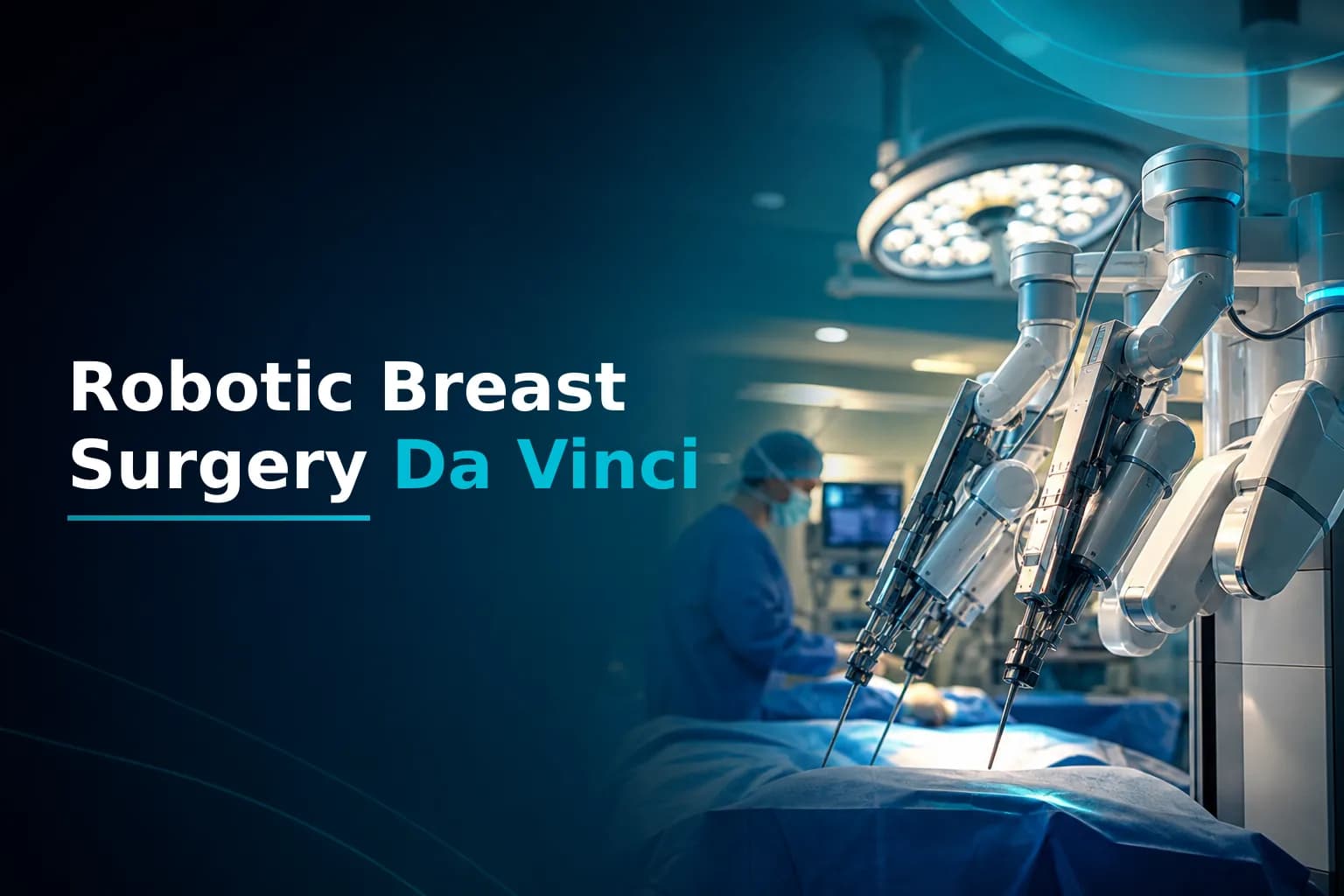
Robotic breast cancer surgery uses a surgeon-controlled robotic system to remove a tumour through small, hidden incisions. The surgeon sits at a nearby console and guides the instruments in real time. The robot does not act independently - the surgeon makes every decision, which translates into precise, tremor-free movements inside the breast.
What does robotic actually mean in breast surgery?
The word robotic sounds alarming at first. In surgery, it does not mean a machine working on its own. A robotic platform is a set of mechanical arms and precision tools that your surgeon controls from a console a metre or two from the operating table.
Think of it as a high-tech extension of the surgeon's hands. The robotic arms translate the surgeon's movements into precise actions, scaled down for delicate tissue work. Natural hand tremor is filtered out. The instruments can move in ways the human wrist cannot. But your surgeon is guiding every single step.
How does the da Vinci system work?
The da Vinci Surgical System - made by Intuitive Surgical - is the most widely studied robotic platform in breast surgery research today. It has three main parts.
- The patient-side cart. This holds the mechanical arms and instruments at the side of the operating table.
- The surgeon console. Your surgeon sits here, viewing a three-dimensional, high-definition image of the surgical area and controlling the instruments with hand and foot controls.
- The vision system. A specialised camera delivers a magnified, 3D view of the operative field - a level of detail conventional open surgery cannot easily match.
The most relevant development for breast surgery is the da Vinci SP (Single Port) system. This version uses one small entry point - typically a 2 to 3 centimetre incision hidden in the armpit fold, known as the axillary approach. Research on single-port robotic approaches to breast surgery describes how the SP system's double-jointed, articulated instruments allow the surgeon to work around the curved contours of the breast through this single hidden access point, without placing any incision on the breast surface itself.
The instruments have a 360-degree range of motion that exceeds what the human wrist can achieve. Combined with tremor filtering and magnified vision, this precision matters when working close to nerves, blood vessels, and the nipple-areola complex.
What procedures can be performed robotically?
Surgeons use robotic techniques to treat several types of breast cancer. The most established in the published literature is robotic nipple-sparing mastectomy.
Robotic nipple-sparing mastectomy
In a nipple-sparing mastectomy, the surgeon removes all breast tissue but keeps the skin envelope and the nipple intact. The cosmetic result after immediate reconstruction is often considerably better than after a conventional mastectomy, which removes the nipple and more of the skin surface.
With conventional open nipple-sparing mastectomy, the surgeon needs a long incision to access and remove all the breast tissue. With the robotic axillary approach, that incision sits in the armpit fold, away from the breast entirely. Once healed, this scar is far less visible than one across the breast.
A meta-analysis pooling data from multiple studies on robotic versus conventional nipple-sparing mastectomy found that the robotic approach had significantly less blood loss and a lower rate of nipple-areola complex necrosis - tissue damage at the nipple - compared to the conventional open technique. Short-term oncological outcomes, including margin clearance, showed no significant difference between the two.
Robotic lumpectomy
Lumpectomy - also called breast-conserving surgery - removes the tumour and a rim of healthy tissue while keeping the rest of the breast intact. Cancer Research UK explains that this approach aims to preserve as much of the breast as possible while achieving clear margins around the cancer. Robotic platforms can perform partial mastectomy through an axillary or peri-areolar incision - around the nipple edge - again avoiding a visible scar on the breast.
Robotic-assisted reconstruction
Some specialist centres offer robotic assistance during immediate breast reconstruction alongside mastectomy - for example, placing an implant in the correct muscle plane with robotic precision. Research into robotic approaches to flap-based reconstruction, which uses the patient's own tissue from the back or abdomen, is in progress.
What are the potential advantages over conventional surgery?
Robotic breast surgery is not the right choice for everyone, and long-term data are still developing. With that caveat clearly stated, current research points to several potential benefits.
- A hidden scar. The axillary approach leaves no visible scar on the breast surface. For many women, the psychological and cosmetic value of this is significant.
- Reduced blood loss. The meta-analysis referenced above found a statistically significant reduction in intraoperative blood loss with the robotic approach compared to conventional open surgery.
- Lower risk of nipple damage. Multiple studies report lower rates of nipple-areola complex necrosis with the robotic technique.
- A superior surgical view. The three-dimensional, magnified vision helps surgeons identify and preserve delicate surrounding structures throughout the procedure.
- Comparable long-term survival data. A review of robot-assisted minimally invasive breast surgery noted no significant differences in five-, ten-, or fifteen-year survival rates across studies when compared to conventional breast surgery.
What are the limitations and trade-offs?
Understanding the trade-offs is important for this decision.
- Longer operating time. Studies consistently report a meaningful increase in theatre time for the robotic approach compared to conventional open surgery.
- Higher cost. Robotic equipment is expensive, training is intensive, and procedural fees are higher as a result.
- Limited availability. Only specialist centres with surgeons trained in robotic breast techniques can offer this. In the UK, that currently means a small number of private hospitals.
- An evidence base still maturing. Most published studies are retrospective and involved relatively small patient numbers. A prospective randomised controlled trial comparing the da Vinci SP system to open nipple-sparing mastectomy is currently in progress, as registered on PubMed. Its results will provide the high-quality long-term data the field needs.
Is robotic breast surgery right for everyone?
No - and any surgeon who claims it's better for everyone should prompt careful questioning. Patient selection is central to good outcomes with this technique.
Robotic nipple-sparing mastectomy tends to be most suitable for women with early-stage breast cancer, smaller tumours not directly behind the nipple, and breast anatomy that allows safe access through the axillary approach. Women with larger or significantly drooping breasts, tumours close to the nipple, certain reconstruction requirements, or serious underlying health conditions might do better with conventional techniques.
If one surgeon said you're not a robotic candidate, a second opinion from a specialist robotic centre could still help. The guide to who is eligible for robotic breast cancer surgery covers candidacy criteria in detail.
What does this mean for UK patients?
Robotic breast surgery is not routinely available on the NHS in England at present. Private sector access is limited to a small number of specialist centres, and fees for robotic procedures are considerably higher than for conventional breast surgery.
This has led a growing number of UK women to explore treatment at specialist robotic breast surgery centres abroad - particularly in India, where high-volume surgical experience and lower procedural costs can make the technique more accessible than UK private care allows for many families. If you are weighing your current surgical pathway against other options, you can contact the Art of Healing Cancer team to ask about robotic options and arrange a remote review of your reports and imaging. Visit the Art of Healing Cancer website to learn more.
For a detailed look at the access and cost picture, the article on NHS waits versus private robotic breast surgery costs covers this in detail.
Questions to bring to your consultation
Whether you are speaking with an NHS breast surgeon, a UK private specialist, or a robotic centre abroad, a few key questions will help you understand what is being offered.
- How many robotic breast procedures have you performed, and what were your personal complication rates?
- What incision approach would you use for my anatomy, and why?
- Would nipple-sparing be achievable in my case, and does a robotic approach change that answer?
- What reconstruction options are available alongside a robotic mastectomy?
- What are my conventional surgical alternatives, and how do outcomes compare in your experience?
The full guide to questions to ask your surgeon before breast cancer surgery is a practical starting point, and the article on how to evaluate a robotic breast cancer surgeon helps you assess the answers you receive.
When to talk to your doctor
If you have recently received a breast cancer diagnosis and are researching your surgical options, raise robotic breast surgery with your breast surgeon or oncology team at your next appointment. Ask whether your tumour size, location, and anatomy make you a potential candidate. If robotic surgery is not available through your current pathway and you want to explore it further, ask about a formal surgical second opinion - your care team should support that request. You can also contact BreastCancer.One to explore your options at your own pace.
This article is for general information and is not a substitute for medical advice. Always consult your oncologist or care team about your specific situation.