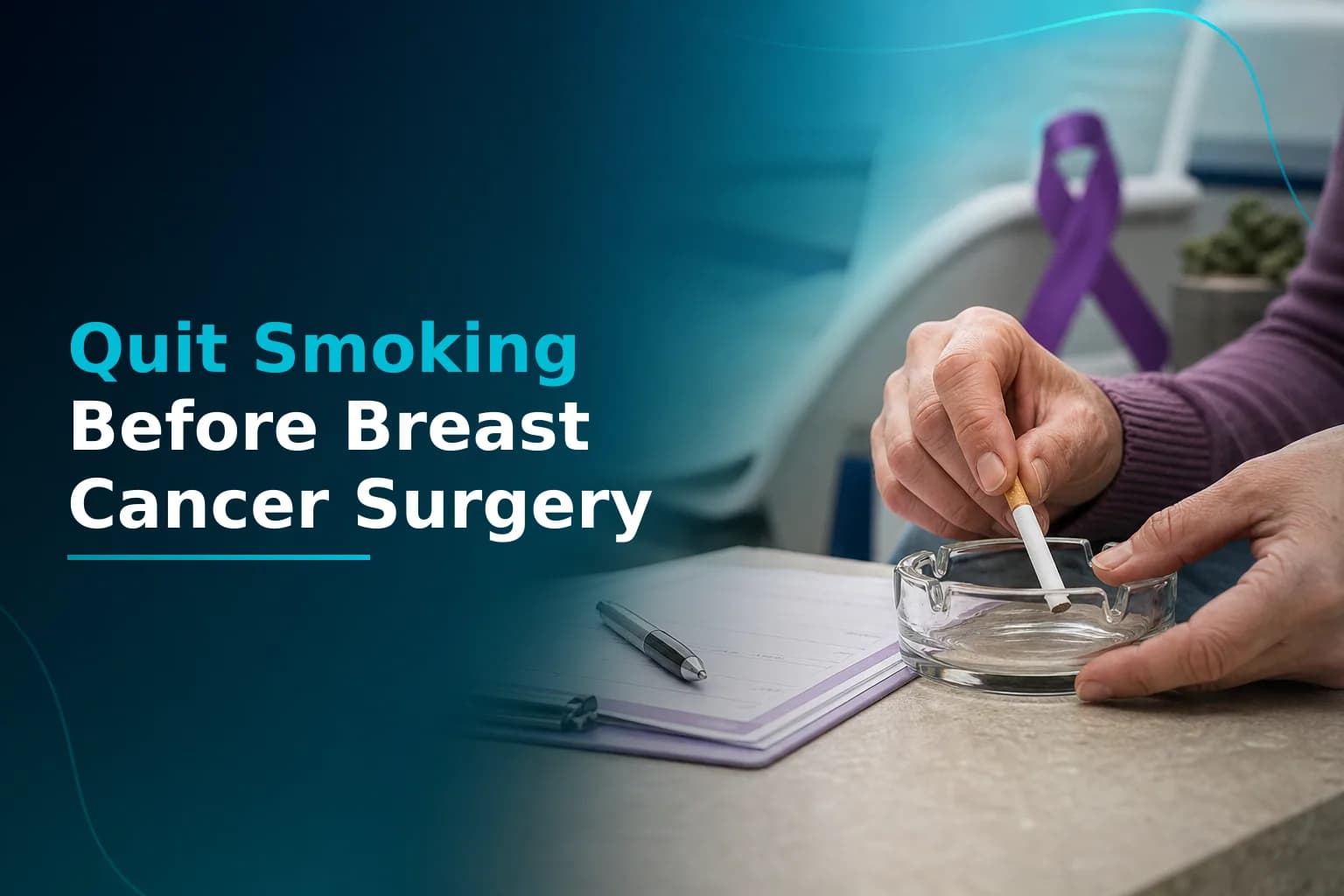
If you smoke and are preparing for robotic breast cancer surgery, the answer is yes - stop as soon as you can. Smoking raises the risk of wound infection, slow healing, and tissue complications after breast surgery. Quitting four to eight weeks before your surgery may significantly lower these risks and help your body heal better.
Why does smoking affect how your body heals?
When you smoke, two key things happen. First, carbon monoxide from cigarette smoke binds to red blood cells and reduces the oxygen your tissues receive - including the surgical area. Second, nicotine narrows your blood vessels, cutting blood flow to healing tissue.
Together, these effects slow your body's repair work. They also slow collagen production - the protein your body uses to close and strengthen wounds. Collagen needs oxygen to grow. This is why smoker wounds close more slowly and develop more complications.
Smoking also weakens your immune system. A weaker immune response makes it harder for your body to fight bacteria that enter during surgery. This raises your risk of surgical site infection.
When you have breast surgery - whether a mastectomy, lumpectomy, or reconstruction - all of these factors matter. Your surgical team mentions this not to lecture you, but to flag a real and avoidable risk.
What specific risks does smoking add to breast surgery?
Research on breast surgery patients who smoke shows concrete risks. A study on surgical site complications in implant-based breast surgery found that smokers had twice the odds of wound complications compared to non-smokers (odds ratio 2.0; 95% CI 1.3-3.2). After accounting for other factors, smokers were roughly twice as likely to develop a wound problem at the surgical site.
A prospective study on breast reconstruction outcomes found that current smokers had significantly higher rates of wound dehiscence (where wound edges pull apart), infection, and flap necrosis compared to non-smokers. Flap necrosis occurs when reconstructed tissue cannot get enough blood and dies. This is one of the most serious complications of breast reconstruction, and smoking is one of its strongest avoidable risk factors.
Smokers scheduled for surgery face on average a 20% increased risk of in-hospital mortality and a 40% increased risk of a major postoperative complication compared to non-smokers, as detailed in this analysis of smoking and cancer surgery outcomes.
These figures are not intended to alarm you. They show that you can make a change right now that may meaningfully affect your surgical outcome.
Does robotic surgery change the smoking risk?
Robotic breast surgery uses smaller incisions than open surgery. This means less visible scarring, less tissue trauma, and often faster recovery. You can read more about what the day involves in our guide to your robotic breast cancer surgery day.
But smaller incisions don't overcome the whole-body effects of smoking. Nicotine and carbon monoxide travel throughout your bloodstream. They cut oxygen and blood vessel function everywhere in your body - not just where a surgical tool enters.
If you are having a robotic nipple-sparing mastectomy with immediate reconstruction, the health of the skin and reconstructed breast depends on good blood flow. Smoking compromises that blood flow. The incision may be small and hidden, but the tissue beneath still needs oxygen to heal.
For women having any form of breast reconstruction alongside robotic mastectomy - whether implant-based or using your own tissue - smoking remains a significant risk factor. Some surgical teams will ask you to stop smoking several weeks before they will consider you suitable for reconstruction at the same time as mastectomy. This is a clinical decision to protect your outcome, not a judgement.
You can explore candidacy factors in more detail in our article on whether you are a candidate for robotic breast cancer surgery.
How long before surgery should you stop smoking?
Four to eight weeks before surgery is when quitting makes the most difference. NICE guideline NG209 on treating tobacco dependence recommends that people having elective surgery should stop as early as possible, with eight weeks before surgery as the ideal target.
A prospective study on wound healing in reconstructive surgery found that patients who had stopped smoking for at least four weeks before their operation healed significantly better than those who quit fewer than two weeks before. Earlier cessation produced even better outcomes.
The good news is that your body starts to benefit quickly once you stop. Carbon monoxide clears from your blood within 48 hours. Blood oxygen levels begin to rise within a few days. Lung function starts to improve within weeks. By four to eight weeks without smoking, your wound-healing capacity begins to move closer to that of a non-smoker - though how far it recovers depends on how long and how heavily you have smoked.
The earlier you stop, the better. But stopping late is still worthwhile.
What about nicotine patches, gum, or e-cigarettes?
Nicotine replacement therapy (NRT) - patches, gum, lozenges, or inhalers - is an effective way to quit smoking. For most of the pre-surgery period, using NRT to help you stop is far better than continuing to smoke.
However, nicotine itself still narrows blood vessels. NICE guideline NG209 specifically advises removing NRT patches at least 24 hours before certain types of reconstructive surgery, particularly microvascular procedures. Your surgical team will give you precise instructions on when to stop using any nicotine product before your operation.
E-cigarettes contain nicotine and other chemicals. Evidence on their effects on surgical healing is less established than for conventional cigarettes, but the vasoconstriction - narrowing of blood vessels - caused by nicotine is a concern with any nicotine-containing product. Many surgical teams treat vaping as equivalent to smoking for pre-operative purposes. If you vape, tell your team honestly.
As your operation approaches, the goal is to have no nicotine in your system. NRT is a helpful bridge to get you there, and your surgical team can advise on exactly when to stop using it.
How to get help quitting in the UK
You can get help. The NHS offers free stop smoking services across the UK. Your GP can refer you and discuss stop-smoking medicines to support your quit attempt. NICE NG209 recommends that patients who smoke and are scheduled for surgery should receive both behavioural support and medicine as early as possible.
Your breast cancer nurse or pre-operative assessment team should also be able to point you to local services. Macmillan Cancer Support provides helpful guidance on what to expect after breast reconstruction, including the lifestyle factors that affect recovery.
Stopping smoking is one of the most important steps in preparing your body for surgery. Our article on prehabilitation before robotic breast cancer surgery covers the full range of steps you can take - exercise, nutrition, sleep, and smoking cessation - to give yourself the best possible start before your operation.
While you work to quit, good nutrition supports your immune system. If you consider nutritional supplements, discuss them with your oncology team first.
What if your operation is soon and you still smoke?
Tell your surgical team. This is the single most important step. If your team doesn't know you smoke, they cannot plan appropriately for your anaesthetic or your post-operative care.
Stopping at any point before surgery is better than continuing to smoke. Concerns about quitting too close to surgery causing harm are not supported by evidence. Patients should stop regardless of timing.
If your operation is within a week or two, stopping now means your carbon monoxide levels will drop significantly before you go under anaesthetic. Your lungs will work better during the procedure. Your wound healing may still be affected by your smoking history, but stopping limits that damage.
Women who are still reviewing their surgical options - including whether to access specialist robotic techniques through a team abroad - should use that planning window to act on smoking cessation as well. If you are considering your options, a specialist consultation may help you think through your approach before committing to a plan.
Smoking, recurrence, and the longer picture
Beyond the surgery itself, continuing to smoke after breast cancer treatment may affect longer-term outcomes. Among patients treated with partial mastectomy and radiotherapy, current smokers had nearly 10% recurrence rates, compared with fewer than 4% in never-smokers and former smokers, as reported in this analysis of smoking status and breast cancer recurrence. The relationship between smoking and recurrence is still being studied. But the evidence consistently points in the same direction.
Quitting smoking matters for your surgery and for your health across your treatment and into survivorship.
If you are in the early stages of planning your surgery and want to talk through your options - including whether robotic breast surgery may be right for you - you can make a discreet enquiry through BreastCancer.One. Female coordinators are available to help you explore next steps at your own pace.
When to talk to your doctor
Speak to your GP or breast cancer care team as soon as possible if you smoke and are approaching surgery. They can refer you to free NHS stop smoking services, discuss medicines that may help, and give you specific advice on NRT timing around your particular operation. If you are unsure whether your smoking history affects your eligibility for a specific surgical approach - including reconstruction - raise it directly with your surgical team at your pre-operative assessment.
This article is for general information and is not a substitute for medical advice. Always consult your oncologist or care team about your specific situation.