
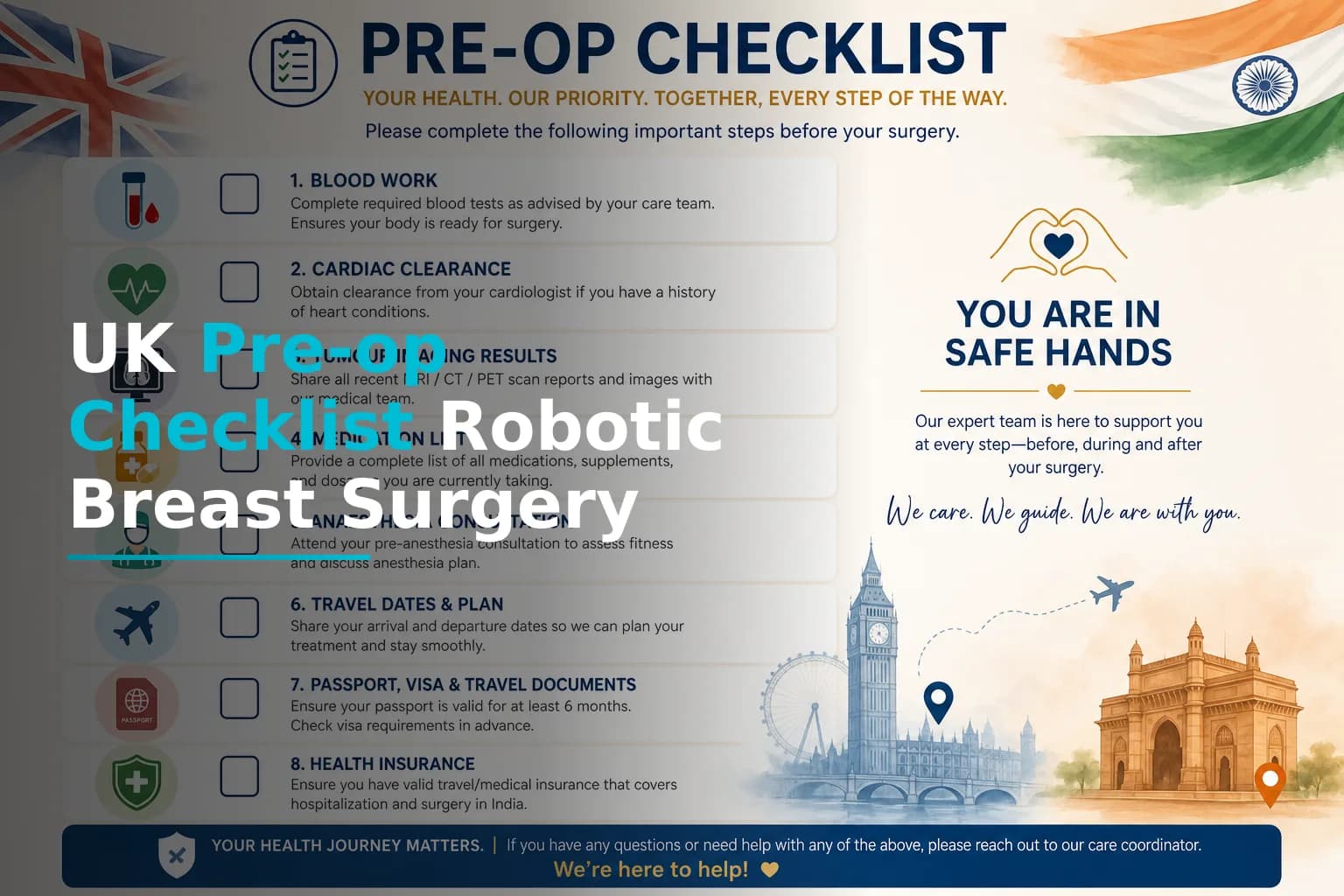
Pre-op Checklist for Robotic Breast Surgery in India
If you're diagnosed with invasive breast cancer and your surgical team recommends robotic surgery in India, you'll need to handle a lot of paperwork before booking a flight. Most of the process follows a clear pattern. Once you know what documents to gather, which tests to arrange, and what to tell your UK care team, preparing for surgery becomes much simpler.
This guide explains the pre-op checklist that UK patients work through before travelling to India for robotic breast surgery. It covers the documents your Indian surgical team will need, the tests they'll request, how to manage your current medications safely, and how to keep your NHS team in the loop.
Every case is different, so always confirm the specific requirements with the hospital you have chosen before you travel.
What do UK patients need to arrange before travelling to India for robotic breast surgery?
Here is a summary of the core steps, which the sections below explain in full:
- Gather all medical documents - biopsy pathology report, digital imaging files, and a GP summary letter
- Complete pre-operative blood tests, an ECG, and any specialist health assessments your team requests
- Review your current medications with both your UK GP and your Indian surgical team
- Complete a short prehabilitation programme covering exercise, nutrition, and lifestyle preparation
- Inform your NHS oncologist and GP about your travel plans in writing
- Arrange specialist travel insurance that explicitly covers planned surgical treatment abroad
- Confirm practical logistics - accommodation near the hospital and a flexible return travel plan
What medical documents should you gather first?
Before your Indian surgical team can confirm your surgical plan, they need to review your full medical picture from the UK. Cancer Research UK notes that your care team needs to understand your diagnosis and overall health in detail before any breast cancer operation. When travelling abroad, you start by gathering the right paperwork and providing it in a format the overseas team can use quickly.
Your pathology report. This is the written result of your biopsy. It should state your tumour grade, the type of breast cancer you have (for example, invasive ductal or invasive lobular carcinoma), your hormone receptor status (oestrogen receptor, progesterone receptor), and your HER2 status. If you don't yet have a personal copy, ask your breast care nurse or GP surgery to provide one. Allow up to two weeks for this to be processed and posted.
Your imaging files. Your team will need digital copies of your mammogram, ultrasound, and any breast MRI you have had. Most UK radiology departments can provide images on a USB drive or via a secure digital link. Contact your imaging department directly to make this request - it does not happen automatically when you ask your GP.
An oncologist or GP summary letter. This letter must confirm your diagnosis, the current stage of your cancer, any treatment already under way (such as neoadjuvant chemotherapy to shrink the tumour before surgery), and a brief summary of your wider medical history. A letter from your GP helps the Indian team understand your baseline health outside of your breast cancer diagnosis.
A full medication list. Include every prescription drug, over-the-counter medicine, and supplement you take - with doses and frequency. Your Indian anaesthetist (the doctor who will put you to sleep for your operation) will need this before they can assess your fitness for a general anaesthetic.
For more details about how your imaging results shape the surgical options available to you, the article on how breast imaging findings shape your surgery options explains what each scan tells your care team and why the imaging type can influence which robotic approach is most suitable.
Which pre-operative tests will the Indian hospital ask for?
Most hospitals offering robotic breast cancer surgery will carry out - or ask you to supply results for - a standard set of pre-operative assessments. The exact list varies by hospital and by your individual health profile, but the following are commonly requested.
A blood panel. This usually covers a full blood count, kidney and liver function tests, and clotting (coagulation) studies. If you have had recent NHS blood tests, ask whether results can be shared electronically with your Indian centre. Most centres ask that results are no more than four to six weeks old on the day of surgery.
An electrocardiogram (ECG). This records your heart rhythm before you undergo a general anaesthetic. Your hospital may accept results from a recent UK ECG, but confirm this in advance. If you have a known heart condition, you may need additional cardiac clearance before the Indian anaesthetist can clear you for surgery.
A chest X-ray or CT scan. This checks that your lungs are clear and helps confirm that there is no spread of disease to the chest wall. Your Indian hospital will advise whether they need this done locally on arrival or whether a recent UK scan will suffice.
An anaesthesia assessment. You'll usually speak with an anaesthetist - either by video call before you travel or in person on arrival in India - to review your overall fitness for a general anaesthetic. If you have pre-existing conditions such as diabetes, a recent cardiac history, or other significant health issues, you may need extra specialist clearance ahead of time. The article on robotic breast surgery with diabetes or heart disease explains what that additional assessment process typically involves and how to prepare for it well in advance.
How should you manage your current medications?
Some medicines need to be paused before surgery, and the timing matters considerably. Your UK GP and your Indian surgical team need to coordinate on this together - do not make changes without their agreement.
Blood-thinning medicines. Anticoagulants such as warfarin, and antiplatelet drugs such as aspirin or clopidogrel, are usually paused for a set number of days before surgery to reduce bleeding risk. Never stop these medicines without clear written guidance from your prescribing doctor.
Hormone treatments. If you are taking tamoxifen or an aromatase inhibitor as part of your breast cancer treatment, speak to your oncologist before making any changes. NICE guidance on early and locally advanced breast cancer recommends that the risks of pausing hormonal therapy around surgery should be weighed carefully against the risk of interrupting treatment. Do not stop oestrogen-blocking treatment without your oncologist's direct approval.
Diabetes medications. The pre-operative fasting period - the hours during which you cannot eat or drink before your anaesthetic - requires careful management if you use insulin or other blood-sugar medicines. Your anaesthetist or diabetologist will advise on the right adjustments to avoid dangerous changes in your blood glucose around surgery.
Supplements. Some over-the-counter products - including fish oil, vitamin E, and herbal preparations such as ginkgo biloba or St John's Wort - may increase bleeding risk or interact with anaesthetic agents. Share your complete supplement list with both your UK GP and your Indian surgical team so that they can advise on what to pause and when to stop it.
Why does fitness before surgery matter - and what should you do?
If your timeline allows it, a short period of physical and nutritional preparation before surgery - known as prehabilitation - is important. Macmillan Cancer Support notes that patients who engage in prehabilitation tend to have fewer complications after surgery, spend less time in hospital, and are more likely to complete their full treatment plan. These are real benefits you can reach in a relatively short window.
Even two to four weeks of moderate activity - such as brisk walking, gentle resistance exercises, or swimming - may support your recovery. Eating enough protein to support wound healing matters just as much, as does reducing alcohol intake and stopping smoking if you smoke. Your GP can refer you to NHS prehabilitation support if it is available locally, or your Indian hospital may offer preparatory guidance directly as part of their international patient programme.
Many patients notice that the weeks before travelling bring disrupted sleep and more worry. That's normal. If you're struggling to sleep before your trip, talk to your GP for support options, or explore products like those at Ayurnomics.
For a step-by-step breakdown of what a structured prehabilitation programme looks like before robotic surgery, the article on prehabilitation before robotic breast cancer surgery covers each component in detail, including the evidence behind exercise and nutritional preparation.
How should you communicate with your NHS oncologist and GP?
Your NHS team does not need to approve your decision to seek treatment abroad, but keeping them fully informed protects your safety at every stage of your journey - both before you fly and after you return home.
Tell your oncologist as soon as your plans are firm. Share the name of the hospital and the surgeon you have chosen where possible. They may flag any clinical concerns based on your specific receptor status or tumour characteristics, or simply be able to confirm that the surgical approach you are considering is appropriate for your case. If you have not yet had an independent review of your UK surgical plan and want one before committing to travel, you can request a discreet second opinion through Art of Healing Cancer - a useful step if you want a specialist robotic breast surgeon to assess your case independently before a final decision is made.
Ask your GP for a medical summary letter. This document lists your health history, current medications, and diagnosis in a format that non-UK clinicians can read quickly. Most GP surgeries are familiar with producing this for patients who travel for treatment, but request it at least three weeks before your departure date.
The NHS page on going abroad for medical treatment confirms that it is your responsibility to arrange the treatment yourself, and that your GHIC (Global Health Insurance Card) does not cover planned procedures abroad. This means you will need separate specialist travel insurance - more on that below.
What practical logistics do you need to arrange before you fly?
Travel insurance. Standard travel insurance excludes planned medical treatment. You need a specialist policy that covers the surgical procedure itself, any in-hospital complications, and a medical repatriation if needed. Read the exclusion clauses carefully before purchasing. Macmillan's travel planning checklist recommends discussing your travel and insurance plans with your care team before you finalise them.
A GP letter for your medications. If you are carrying more than a one-month supply of any prescription medicine, your GP will need to provide a letter confirming the medicines are for your own personal use. Some controlled substances may additionally require an export licence from the Home Office before you can carry them across borders legally.
An international patient coordinator. Ask your Indian hospital whether they have a dedicated international patient services team. Most established centres do, and many offer female coordinators for patients who prefer them - a detail that matters to many women travelling for surgery, particularly those travelling with only one companion. A coordinator can manage your admission paperwork, translate any documents as needed, and serve as your direct point of contact throughout your stay.
Accommodation and return flights. Most hospitals recommend that patients remain close to the hospital for at least seven days after robotic breast surgery before attempting a long-haul flight. Book flexible or refundable return tickets rather than fixed-date ones, so that a short delay in discharge does not become an expensive logistical problem.
What happens when you arrive at the hospital in India?
Most hospitals will ask you to attend a pre-admission appointment one to two days before your surgery date. At this point your blood test results are reviewed, your anaesthetist confirms clearance, and your surgeon will go through the surgical plan in detail with you - including the precise approach that will be used and what you can expect during your recovery.
Bring all your original documents in your hand luggage - not in your checked bags, where they could be delayed or lost. Carry your medications in their original labelled packaging, alongside your GP letter. Keep a digital backup of everything as well. A password-protected cloud folder or a secure email to yourself works well as a backup that you can access from any device if the originals are needed.
Your hospital will give you clear instructions about fasting before surgery - the exact hours during which you must avoid eating and drinking. Follow these instructions precisely. And if anything changes in your health between arriving in India and your surgery date - even something that feels minor - let your care team know straight away rather than waiting until the morning of your operation.
If you are still in the early stages of planning and would like confidential guidance on choosing a centre, preparing your documents, or understanding what to expect from the process, you are welcome to make a discreet inquiry with the BreastCancer.One team. Female coordinators are available for women who prefer them.
When to talk to your doctor
Speak with your oncologist and your GP as soon as you are seriously considering travelling to India for surgery. Gathering the right documents and arranging pre-operative tests takes longer than most people expect - allow at least four to six weeks of lead time between your first inquiry and your travel date. If you have pre-existing conditions such as uncontrolled diabetes, a recent cardiac event, or active thromboembolic disease, build in more time for specialist clearance. Never pause any prescribed medication - particularly hormonal therapy or anticoagulants - without direct guidance from your prescribing doctor.
This article is for general information and is not a substitute for medical advice. Always consult your oncologist or care team about your specific situation.