
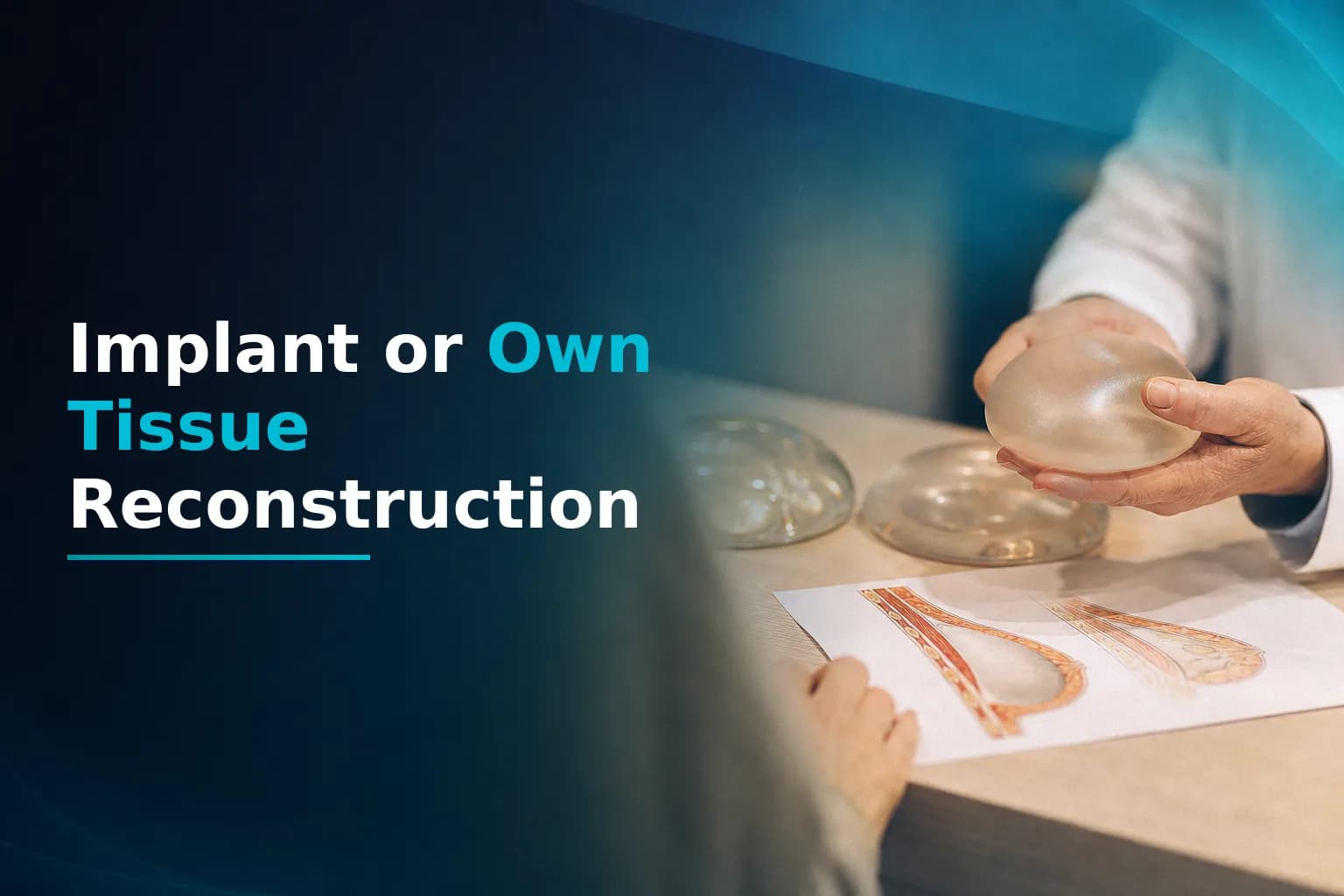
After a robotic mastectomy, you'll face an important decision about breast reconstruction. You have two main options: implant-based reconstruction, which uses a silicone device, and autologous reconstruction, which uses living tissue from your own body. Both are well-established. Both come with real trade-offs in durability, need for further surgery, and how you'll feel in your body over time.
This guide compares revision rates, long-term durability, and patient satisfaction - so you can have a better conversation with your surgical team before you decide.
What are your two main reconstruction options?
After a robotic mastectomy (whether nipple-sparing or skin-sparing), your surgeon can plan reconstruction during the cancer surgery or later. For more on timing, see our guide to immediate vs delayed reconstruction after robotic mastectomy.
Implant-based reconstruction places a silicone device under or in front of the chest muscle. Surgery time is shorter, and most women go home within one to two days. The limitation is that an implant is a foreign device. It can harden, shift, or fail over time, and it may need replacing during your lifetime.
Autologous reconstruction uses living tissue (fat, skin, and sometimes muscle) from another part of your body. Common donor sites are the abdomen (the DIEP flap - deep inferior epigastric perforator flap) and the back (the latissimus dorsi flap). Because the tissue is living and carries its own blood supply, it works naturally with your body and ages with you.
Combined approaches use a tissue flap with a small implant. This helps when there isn't enough donor tissue for full breast volume. Cancer Research UK notes that the right reconstruction choice depends on your overall health, body shape, smoking history, and whether you'll need radiotherapy after surgery.
How do implant and autologous reconstruction compare?
| Factor | Implant-Based Reconstruction | Autologous Reconstruction (e.g. DIEP flap) |
|---|---|---|
| Major complications (long-term) | 30.6% of patients | 8.3% of patients |
| Re-operation for aesthetics | 29.2% | 55.6% (fine-tuning of living tissue, not failure) |
| Effect of radiotherapy | Failure rate rises from 2.4% (no RT) to 7.5% (post-mastectomy RT) | Generally more radiation-tolerant; often preferred when RT is planned |
| Operative complexity | Shorter theatre time; faster initial recovery | Longer surgery; longer initial recovery |
| Long-term durability | Implant may need replacing over time | Living tissue ages naturally with the body |
| Patient satisfaction (BREAST-Q) | Lower scores across most measured domains | Higher scores across all measured domains |
Major complications and re-operation figures: Autologous vs implant-based reconstruction after skin- and nipple-sparing mastectomy (Frontiers in Surgery, 2022). Radiotherapy failure rates: Long-term outcomes of 1,989 immediate implant-based breast reconstructions (PMC, 2025). Patient satisfaction: Breast- and body-related quality of life following autologous vs implant reconstruction (PMC, 2021).
The headline finding: autologous reconstruction has lower rates of major long-term complications and higher patient satisfaction, but the surgery is more complex and recovery takes longer. Implant reconstruction starts faster but is more sensitive to radiotherapy and may need more treatment for complications over time.
What do revision rates really tell you?
Revision rates confuse people because they cover two different things: operations to fix a complication and operations to improve how the breast looks. These aren't the same, and mixing them together can make one option look worse than it really is.
A study comparing autologous and implant-based reconstruction after nipple- and skin-sparing mastectomy found that implant patients experienced much higher major complication rates - 30.6% compared with 8.3% for autologous patients. These extra procedures aren't usually failures. Surgeons can shape and refine living tissue in ways that aren't possible with a silicone device. Many of these procedures are small and planned ahead of time.
What this means for you: if surgery for complications is your main worry, autologous reconstruction may have a much lower risk. If you want to minimize the total number of surgeries, talk with your surgeon about realistic expectations before you decide, because both approaches often need more surgery.
Implant failure over time is something to consider. A study of nearly 2,000 immediate implant-based reconstructions found an overall failure rate of 4.7%, rising to 7.5% in patients who received radiation after mastectomy compared with 2.4% in those who didn't. Implants aren't permanent devices, and many women will need revision or replacement at some point in their lives.
How does radiotherapy affect your reconstruction choice?
If you need radiation after mastectomy - which is more likely when the tumour was large, when lymph nodes were involved, or when surgical margins were close - this factor can shape which reconstruction type is safest for you.
Radiation can cause capsular contracture in implant patients. This is when scar tissue forms and tightens around the implant, making the breast feel hard and sometimes painful, and changing its shape. Research shows that radiation after mastectomy raises the risk of complications in implant-based reconstruction by about 2.6 times compared with patients who didn't receive radiation.
Autologous reconstruction handles radiation better. Living tissue is more resilient to the changes radiation causes in the surrounding area. If your doctor thinks radiation is likely after your mastectomy, many surgical teams will recommend an autologous approach - or suggest waiting to place an implant until after radiation is done.
Talk this through carefully with your team before deciding. If you're unsure whether your surgical plan accounts for the treatment you'll probably need after surgery, you can get a specialist review from the Art of Healing Cancer team.
Which approach suits which patient?
There's no single right answer. Both options can work well in the right person. Here are the factors your team will consider most carefully.
Implant-based reconstruction may suit you if:
- You have a slim build with limited donor tissue at the abdomen or back
- You want a shorter operation and a faster initial recovery
- Radiotherapy is not expected after your mastectomy
- You're comfortable with the possibility of device replacement in later years
Autologous reconstruction may suit you if:
- You want a result that feels and moves naturally over time
- Radiotherapy is part of your treatment plan
- You have sufficient donor tissue, typically at the abdomen
- You're in good overall health and able to manage a longer initial recovery
Women with certain health conditions (including diabetes or significant heart disease) may face higher complication risks with some autologous techniques, especially those needing microsurgery to reconnect blood vessels. For more on how health conditions affect surgical choice, see our article on robotic breast surgery with diabetes or heart disease.
What does patient satisfaction research show?
Patient-reported outcomes consistently favour autologous reconstruction in the medium and long term. The BREAST-Q is a validated questionnaire widely used in reconstruction research to measure satisfaction with the breast, overall outcome, and quality of life.
A long-term follow-up study found that women with autologous reconstruction reported much higher scores on breast-related and body-related quality of life across all measured areas - including satisfaction with the breast, physical well-being, psychosocial well-being, and sexual well-being.
Implant patients did score higher on scar satisfaction. This makes sense because autologous reconstruction creates an extra scar at the donor site (abdomen or back) in addition to the chest scar.
It's also worth noting that the satisfaction gap is narrowing as surgery techniques improve. Prepectoral implant placement (where the device sits in front of, instead of under, the chest muscle) is improving comfort and cosmetic results for implant patients. Many women in both groups report satisfaction with their outcome. What matters most is choosing the approach that fits your body, your treatment plan, and your own priorities - not just the one with the best numbers in any single study.
Planning your reconstruction as a UK patient
In the UK, access to specialist reconstruction varies by centre. Not every hospital offers all reconstruction techniques, and waiting times for complex autologous procedures like the DIEP flap can be longer than for implant-based approaches.
Some UK women choose to get their robotic mastectomy and reconstruction at specialist centres abroad - especially in India, where experienced surgical teams perform both nipple-sparing robotic mastectomy and complex autologous reconstruction, often with shorter waits. The cosmetic results from combining robotic approach and DIEP flap reconstruction are among the reasons UK women are choosing this option. You can read more in our overview of hidden-scar robotic mastectomy and why UK women travel to India.
The weeks of weighing reconstruction options, gathering opinions, and coordinating your surgical plan can be stressful. Many women find that anxiety around these decisions disrupts their sleep. If that's your experience, you may find it helpful to explore the Sleep and Stress range at Ayurnomics as a supportive measure alongside your clinical care.
If you'd like a confidential consultation to review your individual case (including your reconstruction options, cancer characteristics, and likely post-surgical treatment path), you can make an enquiry through BreastCancer.One. Female coordinators are available for every enquiry.
When to talk to your doctor
Talk to your surgeon and breast care nurse before finalizing your reconstruction plan. Ask specifically whether radiation is likely after your mastectomy, because this factor can influence which reconstruction type is best for you. If you feel your reconstruction options weren't fully explained, asking for a second surgical opinion is a reasonable and accepted step in breast cancer care.
This article is for general information and is not a substitute for medical advice. Always consult your doctor or care team about your specific situation.